Document Search
Search our document folder for all types of
information, from MSDS to TDS or User Manuals.
If you have a sales question, please feel free to contact us at:
sales@ntech-inc.com
| Document
Directory |
| Aqueous
Technologies |
| Trident
Defluxing System Training/Installation Guide |

 |
| Batch
Defluxing Cycle Costs |
 |
| Cost
Comparison - Rinse Water Recycling vs. Evaporation (Data) |
|
| Cost
Comparison - Rinse Water Recycling vs. Evaporation (Presentation) |
 |
| Operational
Costs - Batch vs. Inline |
|
| Ersa |
| Tip Savings |
|
| i-Con
Presentation |
|
| Circuits
Assembly - i-Con Article - July 2006 |
|
| Lead-Free Hand
Soldering Tech Paper - Mark Cannon |
|
| Kyzen
Corporation |
| Booster 20
Concentration Calculator |
|
| Non-Volatile
Residue (NVR) Testing - by Tim Wright |
|
| DI Water
Bulletin |
|
PCB Defluxing
How much Booster20 should I add?
Booster20 is an inhibitor used in combination with the Kyzen A4625B
cleaning chemistry. Booster20 is added sump side (meaning when the chemistry is
poured into the cleaning system, as compared to being packaged in the chemistry
itself prior to addition) to the wash solution. Unfortunately, due to the
separating characteristic of the Booster20, it cannot be packaged into the
chemistry,
This additive is required when cleaning Leaded (Pb) alloys, if
unused, you will observe darkened solder joints.
Clicking on the
HTML icon will provide you data based upon a 15% concentration, whereas clicking
on the Excel link will provide you with an Excel Spreadsheet.

What's more efficient, Rinse Water Recycling or Evaporation?
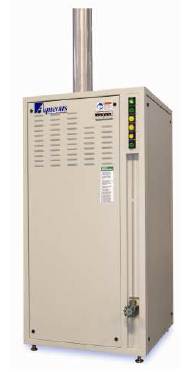
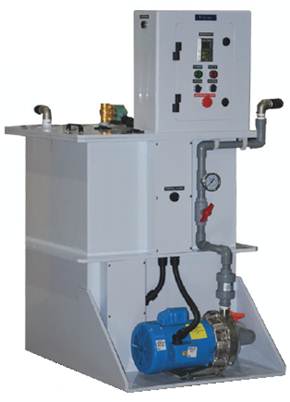
Making
your process "Green" will incur an added cost, when comparing to going
straight to drain. Assessing what those costs will be is key in your
decision of Rinse Water Recycling vs Evaporation. Also, please consider
that evaporation is still exhausting into your environment, but through a vent
stack as compared to a drain. This is a key point in regards to the impact
on your environment, plus it is something that can surely be regulated in the
future, which will cause you to reassess your process again.
In our
experience, Rinse Water Recycling is the best solution. As you will find
the operational costs (media tank exchange) are actually minimal, when you
compare to the operational costs (electricity) involved with the evaporation
process. Not to mention an evaporation process isn't truly green
considering it is still exhausting to the vent and it is using large amounts of
energy to evaporate the drain water.
- Clicking on the PowerPoint icon
will allow you to open or save a PowerPoint presentation of data that we
collected comparing the operational costs of both processes.
-
Clicking on the PDF icon will open a PDF version of the same presentation.
- Clicking on the HTML icon will open up an HTML representation of the data
viewable in your browser
What are typical cycle costs of a batch defluxing process?
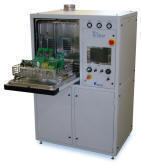 A
batch defluxing process is much more efficient than running an inline defluxing
process, especially in an Aqueous Technologies Trident Defluxing System.
A
batch defluxing process is much more efficient than running an inline defluxing
process, especially in an Aqueous Technologies Trident Defluxing System.
First, a batch defluxer is heating up a much smaller quantity of wash
solution (approx. 3.5 gallons) for use in the wash process; whereas, in an
inline cleaning system you are trying to heat 60 gallons of wash solution.
The difference in energy usage is quite significant in comparison.
Secondly, the separation of wash process to rinse process is
a difficult task. The only effective methods are to increase the footprint
of the machine by elongating the line and creation of an chemical isolation zone
or to accurately place and tune your spray jets to ensure less carry over from
one zone to the other.
The problem is if rinse water makes it into
your wash solution tank, your wash solution concentration will decrease and
cleanliness issues could arise. On the opposite, if too much wash solution
chemistry is making it to the rinse zone, you are washing valuable chemistry
down the drain.
A batch defluxing system, like the Trident, completely
separates the wash process from the rinse process by using separate plumbing for
both process. When the wash process is complete, the Trident returns the
wash solution to a holding tank and actuates a series of solenoids to activate
the rinse process, at which time it brings in fresh DI water to rinse the
PCBs/PCAs. Very minimal amounts of chemistry are wasted, usually the form
of suds on the chambers or PCBs that doesn't return to the wash solution tank,
this is considered your dragout.
We have compiled some data that helps
you to assess what the cost of a cleaning process, you can view this information
by clicking on the HTML icon below. This is an estimated cost per batch,
so remember the more PCBs that can be loaded, means a more efficient process.
Hand Soldering
What are the savings I should see with the Ersa i-Con hand soldering system?
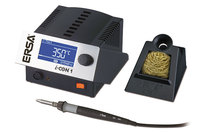 The
Ersa i-Con 1 Hand Soldering system is a state of the art soldering iron system
that gives you the ultimate controls of your hand soldering process. The
engineering of the system takes several factors in account, including:
conveniencem, quality and efficiency.
The
Ersa i-Con 1 Hand Soldering system is a state of the art soldering iron system
that gives you the ultimate controls of your hand soldering process. The
engineering of the system takes several factors in account, including:
conveniencem, quality and efficiency.
The i-Con 1 uses accuracte
thermocouple placement and 150w heating element to provide you with an accurate
hand soldering tool that has sufficient power to quickly recover andythermal
energy that is transferred to the solder joint in the hand soldering process.
This allows you to solder at lower temperatures, rather than compensating
with increased temperatures. This is safer for both your tips and your
components. Lower temperatures can greatly prolong your tip life, which
can save you significant amounts over the life of the soldering stations.
Furthermore, the Ersa i-Con 1 uses i-Tips which have about 2-3 times the
plating of most of our competition. The Ersa i-Tips use approximately
300-600µ of Iron (Fe) plating, in comparison to approximately 100-200µ
of Iron (Fe) plating in our competitors'. This simply means that our tips
will last approximately 2-3 times as long, under the same conditions (time,
temp, etc.); which with the added efficiency of the Ersa i-Con 1 only works
further in Ersa's favor.
Often, the operational costs of a soldering
station are overlooked because a company is already invested in a station.
But we ask you to take a look at the actual costs of your current soldering iron
stations, not what they originally cost you, but what are they costing you now
to keep them in operation?
By clicking on the HTML link you will get a
representation on the potential savings based upon 15 stations.
By
clicking on the EXCEL link you will be able to save and manipulate the data to
your application.